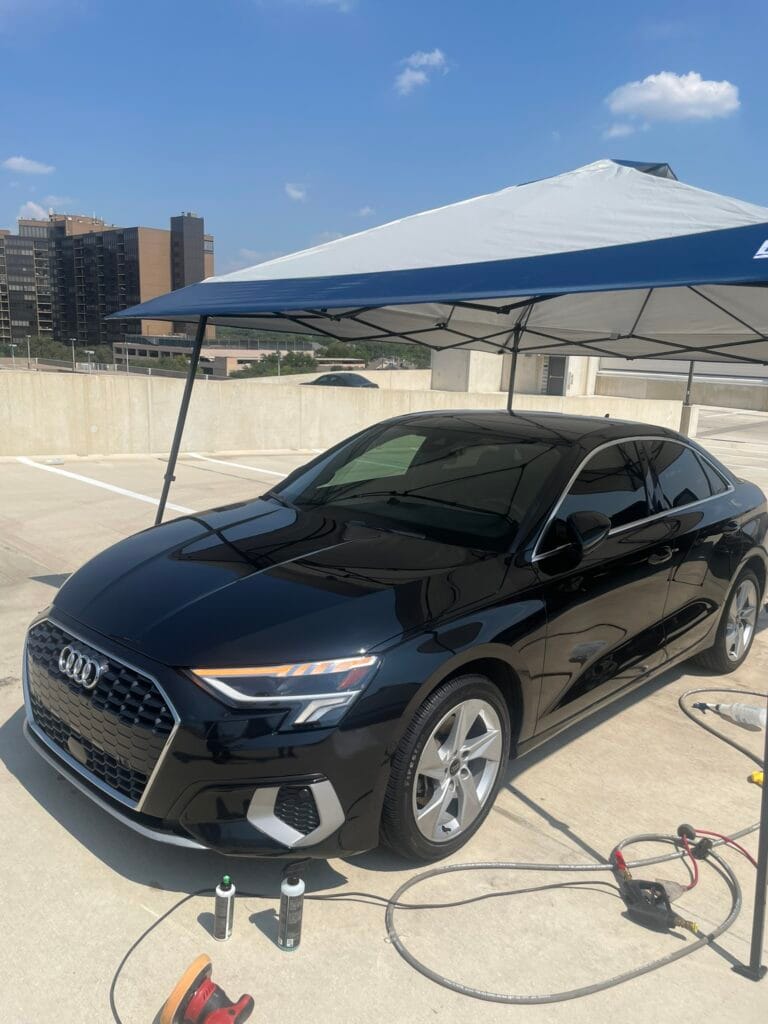
Paint correction is the service I get asked about most — and the one people understand least. Half the people who contact me about correction actually need a polish. A quarter of them need a full multi-stage correction. And a few of them honestly need to save their money because their paint is past the point where correction helps.
After doing 200+ paint corrections across Dallas, Plano, Irving, Frisco, and the rest of DFW, I can tell you within about 30 seconds of looking at a car in direct sunlight whether it needs correction, polishing, or nothing. Here is how you can make a decent assessment yourself.
The sunlight test anyone can do
Park your car in direct sunlight. Not shade, not garage light — actual Texas sun. Stand about 6 feet away and look at a flat panel (hood, roof, or trunk lid) at a low angle, almost like you are looking across the surface.
What you see tells you where you are:
Light haze or spiderweb pattern (fine swirls): This is wash-induced marring. Every car that gets washed develops this to some degree. It is the most common paint defect in the world. A single-stage polish fixes it completely. Most cars I see in DFW fall into this category.
Visible scratches you can feel with your fingernail: These are deeper than swirls. Your fingernail catches in the scratch. These usually require actual paint correction — machine compounding with an abrasive followed by polishing. Whether they come out completely depends on how deep they go. If the scratch is through the clear coat into the color (you can see a different color at the bottom of the scratch), no amount of correction fixes it — that is touch-up paint or respray territory.
Flat, chalky, or cloudy appearance: This is oxidation — the clear coat is breaking down from UV exposure. Light oxidation can be corrected. Heavy oxidation where the paint feels rough and the color is visibly faded may mean the clear coat is too thin to safely correct. We measure clear coat thickness with a paint gauge before cutting into oxidized paint, because removing too much leaves you worse off than where you started.
Water spots that do not wipe off: These are mineral etch marks — hard water deposits baked into the clear coat by Texas sun. Light etching comes out with a polish. Deep etching (you can see and feel the craters) requires correction. Dallas is one of the worst cities in the country for this because our municipal water is extremely hard.
Polishing vs. correction vs. buffing — they are not the same thing
People use these words interchangeably and they should not. Here is what each one actually is:
Buffing is what the drive-through car wash and quick-lube places mean when they say “buff and wax.” It is typically a random orbital with a generic polish applied with minimal time and care. It can improve shine temporarily but rarely removes real defects. And done carelessly, it adds new swirls.
Polishing is a single-stage process using a fine-abrasive compound or finishing polish with a machine polisher. It removes light defects: wash swirls, light haze, minor water spotting. This is what 60-70% of vehicles actually need. It refines the surface without removing significant clear coat.
Paint correction is a multi-step process. Stage one: compounding with a more aggressive abrasive to remove deeper defects (scratches, heavy swirls, oxidation, mineral etching). Stage two: polishing with a finer abrasive to refine the surface the compound left behind. Some cars need a third stage for maximum clarity. Each stage removes a thin layer of clear coat, which is why it is critical to measure thickness before starting and to stop when you have achieved the best result the remaining clear coat allows.
When correction IS worth the money
Before ceramic coating. This is the most common scenario. Ceramic coating locks in whatever is underneath it — flaws and all. If you coat over swirls and scratches, those swirls and scratches are now preserved under the coating for its entire lifespan. Correcting first means you are locking in a flawless finish. Most of our Dallas ceramic coating customers pair it with at least single-stage correction.
When you plan to keep the car. If you are keeping the vehicle for 3+ more years, correction plus ceramic protection has a real ROI. You preserve the paint now while it is still correctable, protect it going forward, and maintain the resale value.
When the defects bother you in daily driving. This sounds obvious, but some people think about paint correction as a luxury. It is not — it is a restoration service. If you see the swirls every time you walk to your car, if the oxidation makes your 4-year-old truck look 10 years old, correction brings it back to where it should be. That is maintenance, not vanity.
When correction is NOT worth the money
I turn away correction jobs. Not often, but regularly. Here is when I tell people to save their money:
The car is getting sold in under 6 months. Unless the paint is so bad it is affecting resale value by more than the cost of correction, a good wash and polish is the better investment before a sale.
The clear coat is too thin. Some vehicles (looking at you, certain German and Japanese factory paint from 2015-2020) come from the factory with thin clear coat. If the paint gauge reads under 80 microns total, aggressive correction risks cutting through to the base coat. A conservative polish is safer.
The damage is through the clear coat. Deep scratches, rock chips, and heavy oxidation where the color has changed — these are body shop repairs, not correction jobs. I will always tell you if your car falls into this category. I would rather lose the job than take your money for a result I cannot deliver.
You use automatic car washes with brushes. If you are going to immediately re-introduce swirl marks by running the car through a spinning brush wash, correction is a waste. Fix the washing habit first. Use a touchless wash, a hand wash, or us.
What it costs and what to expect
In Dallas, professional paint correction starts at $450 for single-stage on a sedan. Multi-stage on a full-size truck can run $849. The variables are vehicle size and how many correction stages your paint needs. We assess every car individually — there is no way to accurately quote correction without seeing the paint in person.
Time: single-stage takes 4-6 hours. Multi-stage takes 8-12 hours. We do not rush this. Every panel gets checked under inspection lighting before we move on.
The result: on a vehicle with moderate defects, correction brings the paint back to near-showroom condition. It is not an exaggeration. The before-and-after in direct sunlight is dramatic — haze and swirls disappear, depth and clarity return, and reflections become crisp instead of muddy. We photograph the results because people genuinely do not believe it is the same car.
If you want to know what your specific vehicle needs, use the price estimate for a ballpark, or call us at (945) 233-7397 to schedule an assessment. We serve all of Dallas and DFW — we come to you with everything, including the inspection lighting.


